KitKat in the news…
Now that I've finally watched both documentaries about KitKat Club, I'd like to share my thoughts. As a regular visitor and fan of the club, I certainly have an opinion. ;-)
First, a little background. There are currently two documentaries about KitKat Club. One Night at KitKat is available to stream for free on German public broadcaster ARD. Kinks of Berlin was shown in cinemas and will also be available to stream on ZDF, which co-produced the film.
Why two documentaries about the same club came out around the same time remains a mystery to me. In any case, they're quite different from each other, although they do share a few similarities.
The most obvious one: they're both about the same club! A club that famously doesn't allow cameras inside and doesn't even let visitors bring their phones in. Yet somehow, two camera crews were granted access to film there.
Simon Thaur, one of the club's founders, features in both documentarie. We also hear similar stories, with visitors talking about the freedom they experience at KitKat. Beyond that, however, the films take very different approaches – including in the way they portray Thaur.
One Night at KitKat: Almost an advertisement?
I'd describe One Night at KitKat as a fairly mainstream documentary about a nightclub. It follows a straightforward documentary format, interviewing various key people: the owners, a bouncer, other employees and several guests. At times, it feels more like a promotional film than an independent documentary.

It gives us a pretty straightforward look at what goes on inside the club – and does so with surprisingly little censorship!
It also gives the club an opportunity to address one of the major criticisms it has faced in recent years: the lack of an awareness team or a clear awareness concept, and the perception that almost anything could – and sometimes did – happen inside, including unsolicited sexual advances and non-consensual sex.
We hear and see what attracts people to KitKat: the freedom, the acceptance, and the opportunity to be yourself without being judged.
Kinks of Berlin: A deeper look into the scene
Kinks of Berlin is a very different film.
It shows intimate portraits of a diverse group of people, ex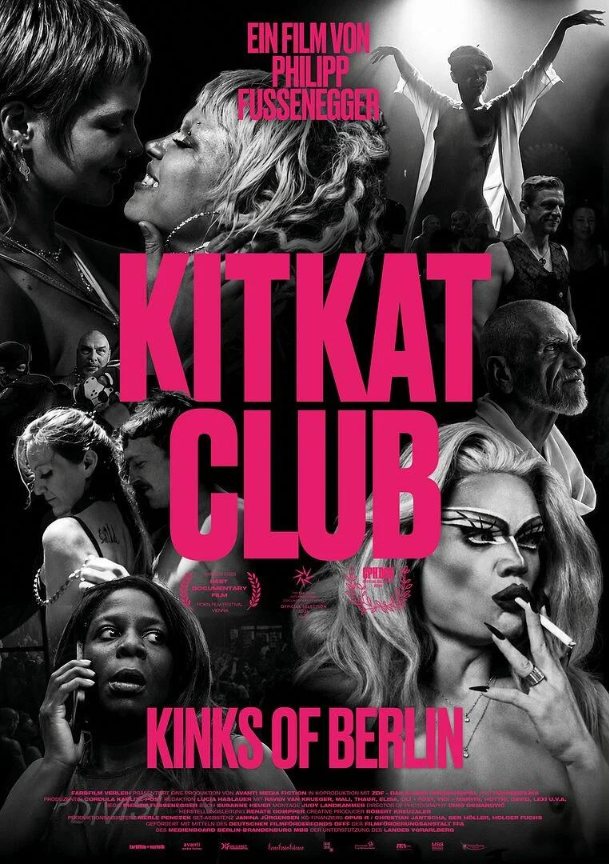 ploring their motivations, emotions and struggles. We meet the couple Oli and Foxy, who are sweetly caressing each other in one scene and then engaging in anonymous sex at the FickstutenMarkt party. We see Thaur's partner confronting him about his selfishness, and we follow someone struggling with drug use, among other stories. The film is less about KitKat itself and more about the individuals who happen to share this particular club.
The documentary isn't especially critical of KitKat either. But it explores so many different aspects of the scene that it feels much less like an advertisement than One Night at KitKat. Drug use, for instance, is absent from the latter, whereas Kinks of Berlin follows someone struggling with drug use and includes several scenes in which drugs are openly consumed – which is surprising, given that the club officially bans drug use.
One of the protagonists is also devastated after receiving a club ban (Hausverbot), although we never find out what they did to deserve it.
The film takes a more artistic approach, with beautiful black-and-white cinematography and intimate portraits and conversations. It goes beyond the club, exploring the people themselves: their lives, motivations, emotions and struggles.
So, what do the two films tell us about KitKat?
Both documentaries made me want to go straight back to KitKat.
They show that KitKat is much more than a nightclub where people dance and have sex. It's a place where pretty much every fetish is welcome.
That doesn't mean everyone is welcome. Plenty of people get rejected at the door, and certain behaviour will get you kicked out. But those who find their place in the club often feel at home there – and, in a way, safe.
The documentaries also show some of the wonderfully weird things that make KitKat stand out: the swimming pool and sauna, classical music concerts, tango nights and unexpected performances on stage.
Why KitKat matters to me
My first visit to KitKat, about ten years ago, was an eye-opener. I was overdressed (that was the last time!).
But more importantly, I felt at home. A club where I could wear what I wanted and express myself without constantly being judged or harassed. And if I feel like it, I can have sex wherever I want - except the toilets (great scene in Kinks of Berlin).
Of course, that doesn't mean boundaries are never crossed. There are moments when I have to make my boundaries very clear. KitKat isn't some magical place where everything is automatically safe or everyone behaves perfectly.
But I do agree with one of the protagonists in One Night at KitKat: in most other clubs, I couldn't walk around in a skin-revealing rubber outfit without attracting stares or comments.
And that's an important distinction. At KitKat, your outfit isn't something you put on just to get in. For me, wearing rubber is a way of expressing myself, and KitKat is a place where I can do that without having to explain myself.
Maybe that's why, despite all its contradictions and imperfections, KitKat still feels like home to so many of us.